Weathering and Erosion
& Groundwater
Objectives
I) Weathering
1) Explain the difference between weathering and erosion
2) Describe three types of physical (i.e. mechanical) weathering and three types of chemical weathering
II) Mass Wastage
1) Define mass wastage
2) Explain five types of mass wastage
3) Describe preventative actions humans can take to reduce mass wastage
III) Karst Topography and Running Water
1) Explain how Karst Topography forms
2) Describe the four major landforms associated with karst topography
3) Define the terms spring, artesian well, permeable rock, impervious rock, aquifer
4) List four ways that groundwater is important to humans


Let's look at Gradational Processes. These are the forces that are trying to level the earth through weathering and erosion.

Introduction

- erosion and weathering are part of the forces of gradation which do battle with tectonic forces
tectonic forces: strive to build up rock structures
gradational forces: strive to bring rock structures to a level or a uniform slope; this can be done in two ways--by tearing down (i.e. degradation or erosion) or filling in (i.e. aggradation or deposition)

- erosion can be divided into two processes:
a) the breaking up of rock masses (i.e. weathering )
b) the carrying away of the weathered rock fragments (i.e. transportation )

- cycle of gradation: weathering, transportation, and deposition


I) Mechanical or Physical Weathering

- the breaking up of rocks into smaller fragments without any change in the chemical composition of its minerals

a) exfoliation or spheroidal weathering
- daily variations in temperature cause rocks to expand and contract
- various minerals in a rock expand and contract at different rates; as a result there is a gradual splitting apart of the rock
- in humid climates, running water tends to round off the surface features
causing the "skin" of the rock to peel off
- this is also an important form of weathering in desert areas where the daily temperature range can be high

b) freeze-thaw or frost action
- when the water in the cracks and pore spaces of rocks freezes, the force created by its expansion is tremendous
- rocks are literally split apart resulting in shattering

An example of the powerful force of freeze thaw action on a large boulder.


A glacial erratic near Vernon, BC (Courtesy: P. Mleziva)

c) plants and roots
- tree roots, for example, growing down into cracks can exert powerful forces
- even mosses and lichens can help to split rocks apart

II) Chemical Weathering

- the decay of rock through actual chemical change in the composition of its minerals
- most common in warm and humid climates where both water and heat speed
up chemical reactions

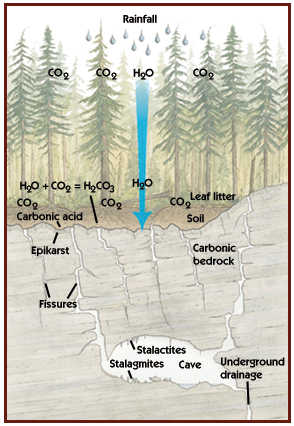
a) carbonation or solution

- occurs with limestone (easiest to erode)
- ground water absorbs carbon dioxide to form a slightly acidic solution
- destroys joints (joint: line of weakness in a rock) and bedding planes to form karst topography (Courtesy: About.com)

Other Karst Links:

Karst in British Columbia
Courtesy: Government of British Columbia

Karst Topography and Mass Wasting
Courtesy: Dylan Prentiss


Courtesy: Earth Science Australia

b) hydrolysis
- occurs especially with granite
- causes rock to whiten (erodes slowly)
- creates clay

c) oxidation
- creates rusty red rock
- occurs especially with rock containing iron nitrate
- erodes and forms soil

d) hydration
-
occurs especially with rocks containing salt minerals
- water is absorbed into the internal structure of the rock causing swelling and making it vulnerable to breakdown due to pressure and potential chemical structure changes
- a physio-chemical process
eg gypsum results from water being added to anhydrite (CaSO4)

General Rule: igneous and metamorphic rocks are more susceptible to chemical decomposition
than mechanical disintegration, while the reverse is true for sedimentary rocks
A notable exception to this is limestone.

III) Mass Wasting

- the downhill movement of weathered rock materials (i.e. regolith) by creeping, flowing, sliding, slumping, and falling
- angle of slope, gravity, and water all affect the rate of mass wasting
- human activities such as deforestation, the building of settlements, farming, and mining can increase the instability of slopes

Types of Mass Wasting

Courtesy: University of Texas

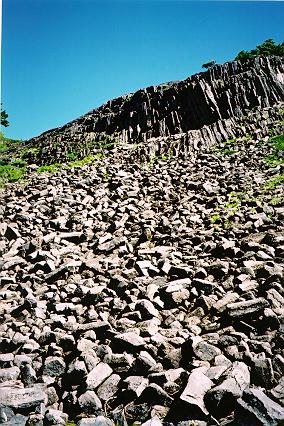
A collection of angular rock fragments at the base of a slope is called talus or scree as seen below in Mt. Baker-Snoqualmie National Forest, Washington State.


Courtesy P. Mleziva

IV) GroundWater

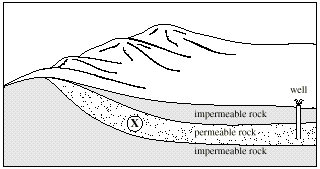
An aquifer is a an area of rock under the earth's surface that holds large quantities of water. Area X in the diagram below represents an aquifer.

GroundWater in British Columbia


Assignment Work

1) Download and complete the Weathering and Erosion & Groundwater Exercise utilizing the information above as well as the links. E-mail your completed work to your instructor as a word document attachment. This assignment is worth 10 marks.

©www.coolschool.ca
Press the button on the Action menu to proceed.